How Modular Construction in Healthcare Supports ADA Compliance in Patient Bathrooms
 ADU Housing
 April 17, 2026
In this Article
Summary:
- Explains how modular construction ensures ADA-compliant patient bathrooms
- Covers key ADA requirements and challenges in traditional builds
- Shows how factory-built pods improve precision and consistency
- Highlights cost, time, and risk reduction benefits
- Compares modular vs traditional construction
- Positions modular as a scalable, compliant solution for healthcare
The patient bathrooms in hospitals and care centers function as more than basic bathroom facilities. The space serves as a testing area for wheelchair users who will attempt their first independent movement, and it also serves as a treatment area where nurses assist patients with post-surgery cleaning tasks. The bathroom experience changes from easy to difficult when an ADA non-compliant bathroom is present.
The Americans with Disabilities Act (ADA) establishes bathroom regulations that require particular bathroom specifications that include clear floor space, turning radius, grab bar installation, door width measurement, and fixture height standards. The healthcare industry applies those regulations with strictness because patients may experience various mobility challenges, which include complete dependency on their mobility devices.
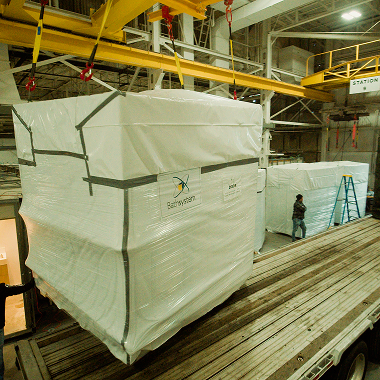
The construction process for traditional on-site projects needs to establish dependable building methods that do not exist at present. Bathroom construction requires workers to complete all three stages, which include framing work and rough-in work, and finishing work through manual methods. The accumulation of small variations creates a significant issue. The modular construction method solves the issue through a different approach, which involves designing a factory-built bathroom pod for one bathroom that will be used in multiple locations. The design process establishes automatic ADA compliance in every product, which eliminates the need for compliance checks after the product development process.
1. What Is ADA Compliance in Patient Bathrooms?
Bathroom design needs to meet ADA compliance standards which require accessible entry and bathroom fixture usage and safe exit for people with disabilities. The 2010 ADA Standards for Accessible Design define the technical requirements: how much clear floor space is needed, where grab bars must go, how wide doors must be, and how high fixtures are allowed to be.
In healthcare, those rules are applied tightly because patients are more vulnerable. Typical ADA‑related elements in patient bathrooms include:
- Clear floor space for wheelchairs around toilets, sinks, and showers.
- Grab bars should be placed at the right height and with enough strength near toilets and in showers.
- Accessible sinks and toilets—with knee clearance, reachable heights, and proper clearances.
- Door widths (minimum 32 inches) and a 5‑foot turning radius so wheelchairs can enter and turn without hitting walls.
- Roll‑in or curb‑less showers, with slip‑resistant surfaces and proper drainage.
If any of those details are off by just a few inches, the bathroom can fall out of compliance. That’s why the method used to build the bathroom is as important as the design.
2. Challenges of Achieving ADA Compliance with Traditional Construction
On paper, every bathroom can be ADA‑compliant. In practice, on‑site construction creates a few recurring problems.
2.1 On‑site variability
Every bathroom is built separately. A stud moves a bit here, a wall shifts a little there, or a threshold is set higher than planned. Across many rooms, those small differences add up and change clear floor space, turning radius, or grab‑bar placement.
2.2 Coordination complexity
Plumbing, electrical, framing, tile, and drywall all intersect in the bathroom. When one trade assumes something about where a grab‑bar backing will be, or where a threshold will land, the pieces don’t always line up. Fixing those issues in the field is messy and expensive.
2.3 Inspection delays and rework
The inspector starts rework when he discovers a door that does not meet standards, an improperly placed grab bar, and a shower curb that exceeds its approved height. The process requires wall demolition, plumbing relocation, and tile restoration. The project will experience delays because of this issue, which also increases expenses and puts additional pressure on hospitals that operate under strict time constraints.
The main finding shows that even minor mistakes that occur throughout numerous areas of a project lead to substantial delays and budget excesses that affect the entire project.
3. How Modular Construction Improves ADA Compliance
The solution to these problems first establishes factory-based bathroom construction as an alternative to traditional on-site bathroom construction.
3.1 Factory‑controlled precision
The factory produces modular bathroom pods through standardized manufacturing methods, which use identical testing equipment throughout their production process. The design establishes permanent specifications for clear floor space, turning radius, door clearances, and fixture heights, which the design team will use to create every unit.
3.2 Pre‑tested and pre‑validated designs
The layout design undergoes ADA dimension verification before any modules are sent out for delivery. The testing process evaluates grab-bar anchor strength, door space requirements, and shower drainage system installation slope measurements. The “design once, build many” method decreases the possibility of inspection failures that occur at the last moment.
3.3 Integrated systems approach
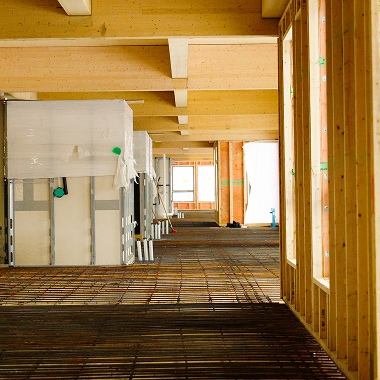
Modular construction requires factories to install plumbing systems together with electrical systems and all building fixtures. The bathroom pod appears on the construction site as a nearly finished bathroom unit because it comes with installed walls, tiles, and bathroom fixtures. The method decreases work overlap between different trades while minimizing the chance that components will become misaligned.
3.4 Consistency at scale
Modular construction enables hospitals and multi-unit healthcare centers to create multiple identical bathroom units which total up to 100 bathrooms. The unit preserves an ADA-compliant layout that all users can easily manage because it uses identical design elements throughout.
4. Key ADA Features Built into Modular Bathroom Pods
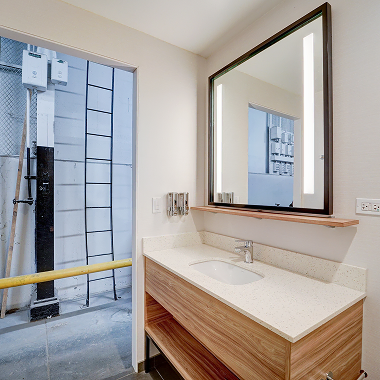
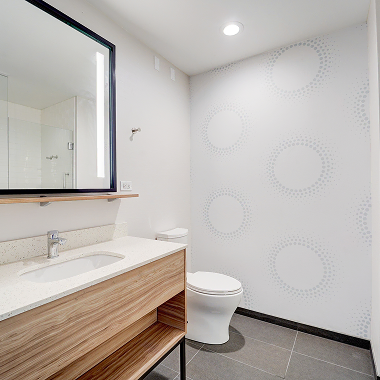
Modular bathroom pods don’t approximate ADA compliance; they build it in as part of the standard unit. Typical features include:
- Pre‑installed grab bars with the right load‑bearing strength, located at toilets and showers exactly where the standards require.
- Wheelchair‑accessible layouts built around required clearances and a 5‑foot turning radius.
- Slip‑resistant flooring applied in a controlled environment so texture and slip‑risk are consistent.
- Fixture heights and spacing set to ADA‑friendly ranges for sinks, mirrors, and toilets.
- Accessible shower designs, including roll‑in showers, low or no‑curb entries, and options for built‑in seating.
Key insight: In modular construction, compliance is part of the unit’s core design, not an after‑the‑fact fix.
5. Cost and Risk Benefits of Modular Construction for ADA Compliance
Beyond meeting the law, modular construction brings real benefits:
- Reduced rework costs, fewer measurement errors, and misaligned components mean fewer callbacks to move grab bars, reset doors, or rework showers.
- Faster approvals, since each pod is pre‑validated, inspections often go smoother, with fewer corrections.
- Lower liability for contractors, code‑compliant, pre‑tested systems reduce the risk of ADA‑related claims.
- Predictable project costs and fewer surprises mean budgets stay closer to estimates, and schedules are easier to protect.
Key insight: Compliance built in up front is far cheaper than correcting it in the field.
6. Speed to Completion in Healthcare Projects
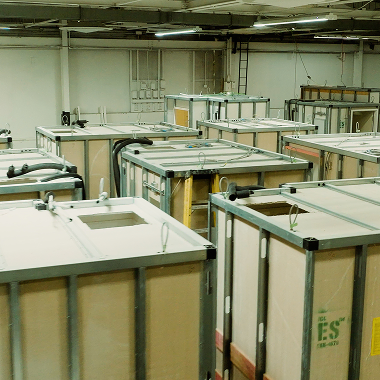
Healthcare facilities cannot operate their services for three weeks because their restroom facilities require repairs. Modular construction enables bathroom pods to be manufactured in factories while construction progresses on other building components.
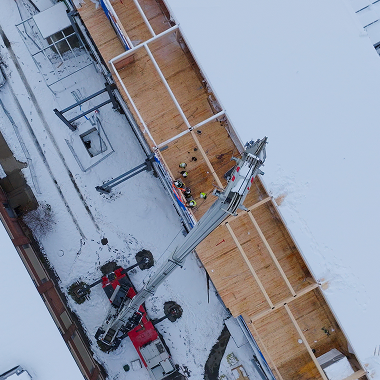
The installation process begins after the building’s exterior construction is finished because crew members will install pods and establish utility links between all areas of the facility. The installation process requires less time and causes less disruption when compared to traditional wet-area construction because most installation work for rough elements and tiles and fixtures takes place at another location. Hospitals require this solution because they must limit both sound production and dust generation in their facilities.
7. Design Flexibility Without Compromising Compliance
Modular construction doesn’t mean every bathroom is the same. Layouts can be adapted for different use cases:
- Standard patient rooms
- ICU units
- Rehab centers
- Long‑term‑care suites
Within each type, layouts can stay within ADA‑defined clearances and turning‑radius rules, while finishes and colors can follow the project’s design intent. That mix of flexibility and consistency is useful for large systems that need uniform standards.
8. Modular Construction vs Traditional Bathrooms in Healthcare
| Factor | Modular Construction | Traditional Construction |
|---|---|---|
| Measurement accuracy | Factory-controlled, repeatable | Subject to site drift |
| ADA compliance risk | Low (designed once, repeated many times) | Higher (errors found at inspection) |
| Trades coordination | Minimal (pod is largely pre-built) | Complex (many trades, many handoffs) |
| Inspection speed | Faster, fewer rework cycles | Slower, with callbacks |
| Cost predictability | More stable, fewer fixes | More volatile, with hidden fixes |
Key takeaway: Modular construction reduces the variability that’s often the biggest risk in ADA compliance.
9. When Modular Construction Makes the Most Sense in Healthcare
Modular construction fits best when:
- Projects involve large‑scale hospital expansions with many patient rooms.
- The facility is a multi‑unit healthcare environment (rehab, long‑term care, behavioral health).
- Timelines are tight, and delays are hard to absorb.
- The team needs repeatable design standards across multiple units or campuses.
In those cases, modular bathroom pods help healthcare teams deliver safer, compliant spaces faster and with fewer surprises.
Why Modular Construction Is a Smarter Approach to ADA Compliance
Healthcare organizations must achieve ADA compliance because it serves as an essential standard for protecting safety and accessibility and maintaining legal defenses. The traditional on-site approach can accomplish its goals but requires extensive rework and carries significant danger. Modular construction provides a better solution for patient bathrooms because it delivers results with known market performance.
Modular construction achieves ADA compliance because it combines factory-controlled precision with pretested layouts and integrated systems and consistent quality during large-scale operations. Modern facilities achieve legal compliance while minimizing risks and enhancing patient experiences because they maintain control over their financial expenditures and project timelines.
Building Compliant, Future‑Ready Healthcare Spaces
Bathrooms in healthcare facilities must accommodate every user, which requires more than basic solutions that meet average user needs. The building’s accessibility system functions as a continuous operation, which designers must develop from the start until they complete their work. The modular construction method provides healthcare facilities with bathroom spaces which designers constructed to meet accessibility standards and which they built according to established standards and which their teams can install with fast efficiency. At Bathsystem USA, this approach is applied through engineered modular bathroom pods designed specifically for healthcare environments.
As healthcare projects grow in size and complexity, facilities require methods that provide exact results instead of relying on uncertain estimates. The modular construction method enables the creation of ADA-compliant patient bathrooms, which deliver predictable results in three areas: cost, performance, and construction schedule.
CTAs
- Request technical specifications for ADA‑compliant bathroom pods
FAQs
How does modular construction ensure ADA compliance?

Pods, which are manufactured in factories, do so according to ADA specifications through their pre-approved design layouts, which guarantee continuous ADA compliance.
Are modular bathroom pods approved for healthcare use?
The products satisfy all requirements of ADA and IBC and healthcare standards, which make them suitable for use in medical facilities.
Do modular bathrooms limit design flexibility?
The architectural design of spaces can be customized by designers who want to achieve ADA standards through their design work.
Is modular construction cost-effective for healthcare projects?
The method helps to decrease all expenses that result from construction delays and necessary rework.
How do modular bathrooms impact project timelines?
The system accelerates construction work through its ability to build components at remote locations, which enables swift assembly work.

Written By
Riccardo SciontiRicardo Scionti is the CEO of Bath System America (Bathsystem USA), a U.S.-based company built on European engineering and manufacturing expertise. He leads the growth of prefabricated bathroom and kitchen pod solutions across the United States, serving the hospitality, healthcare, and multifamily markets. With more than eight years of experience in the U.S. modular construction industry, Ricardo works closely with architects, developers, and general contractors to ensure every project is executed successfully. Supported by a highly skilled professional team, he is actively involved in every stage of the process, from design coordination to manufacturing and on-site integration—ensuring the highest standards of quality, precision, and speed to market. Through these blogs, Ricardo shares practical insights and real-world expertise to help shape the future of industrialized construction.
Related Blogs

Have a project in mind? We'd love to chat!
We’re redefining how our industrialized construction of modular bathroom pods and kitchen pods is delivered across the nation—with precision, reliability, and innovation built into every project.
Let’s build something exceptional together.