How Modular Bathroom Is Quietly Solving the Construction Labor Shortage Crisis in 2026
 Hospitality
 April 8, 2026
In this Article
Summary:
|
The pressure points at construction sites become apparent when you visit the site today. The project continues to progress while the required skilled workers remain inaccessible.
The project teams need to work with reduced staff members and complete their tasks within shorter timeframes while achieving higher performance standards.
The most significant pressure point shows its effects through several different areas. The building’s main structure remains intact while its smaller areas depend on multiple trade workers to execute their work precisely. Bathrooms serve as a perfect demonstration of this situation.
The process needs particular steps to be followed with complete precision, while artisanship skills need to be developed at an increasing difficulty level, which now serves as a constraint.
The modular bathroom system is currently beginning to provide new solutions for the problem. The system transfers most of its operations from the construction site to a dedicated workspace, which leads to more predictable outcomes while decreasing the need for limited workforce resources.
The project teams currently face existing operational restrictions because they see this option as their best available solution to proceed.
Understanding the Construction Labor Shortage in 2026
There’s no single reason behind the labor shortage, which is why it’s proving difficult to fix.
A lot of experienced workers have aged out. Fewer new workers are entering trades. At the same time, demand hasn’t slowed, if anything, it’s picked up across sectors.
On a typical project, that translates into a few familiar patterns:
| What’s happening | What teams deal with on-site |
|---|---|
| Fewer skilled workers are available | Delays in specialized tasks |
| Subcontractors stretched thin | Scheduling conflicts |
| Rising wages for trades | Budget pressure |
| Complex project requirements | Increased supervision and coordination |
General contractors end up juggling all of this at once. And when resources are tight, the most complex scopes become the hardest to manage.
Bathrooms usually sit at the top of that list.
Why Bathrooms Demand So Much Labor
It’s not just the number of tasks, it’s how tightly they’re linked.
You can’t tile before waterproofing is done. You can’t finish fixtures before plumbing is aligned. And none of it works if dimensions are even slightly off.
Here’s what typically goes into a single bathroom:
- Plumbing rough-ins and testing
- Electrical work and fixture installation
- Waterproofing systems
- Tiling and surface finishing
- Final fittings and inspections
Now imagine coordinating all of that across dozens, or hundreds, of units.
A few common friction points:
- Trades working over each other in confined areas
- Delays caused by inspection sequencing
- Rework when tolerances aren’t met
- Increased reliance on highly skilled labor
It’s not unusual for bathrooms to slow down an otherwise well-running project.
How Modular Bathroom Pods Change the Work Itself
What the modular bathroom does is simple in concept, but significant in impact—it moves the complexity somewhere else.
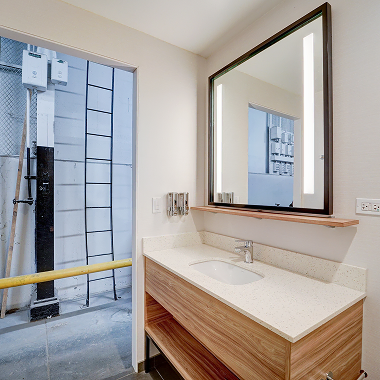
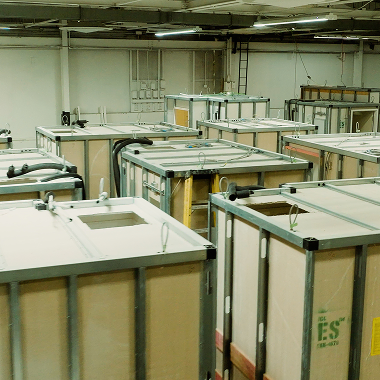
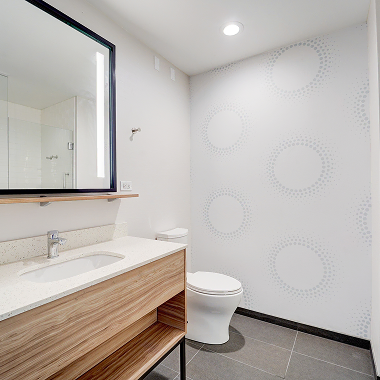
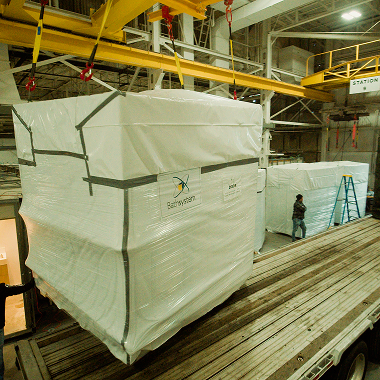
Instead of building bathrooms piece by piece on-site, entire units are assembled in a factory. By the time they arrive, most of the work is already done.
That shift leads to a different kind of workflow:
- Less dependence on multiple trades working in the same space
- More predictable production timelines
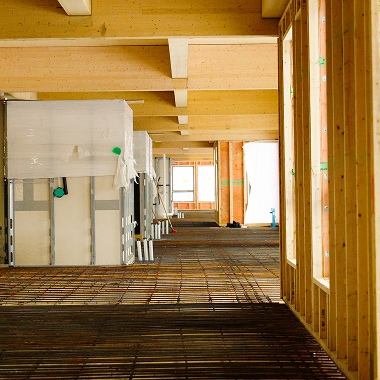
- Site teams focused on installation rather than construction
- Ability to run building work and bathroom production at the same time
A quick comparison makes it clearer:
| Traditional Approach | Modular Bathroom Approach |
|---|---|
| Built step-by-step on-site | Built as a complete unit off-site |
| High trade overlap | Minimal on-site trade coordination |
| Sequential progress | Parallel progress (site + factory) |
| Frequent adjustments | Pre-engineered and tested |
The work doesn’t disappear; it just happens in a more controlled environment.
Speed, Predictability, and Fewer Surprises
One thing contractors notice fairly quickly with modular is the change in pace.
On a traditional site, timelines tend to shift as trades move in and out. Even small delays can ripple through the schedule.
With modular bathroom installation, things feel different:
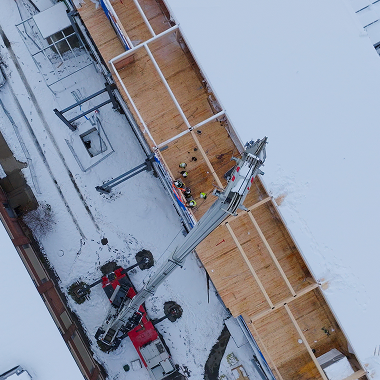
- Units arrive ready for placement
- Installation follows a more repeatable pattern
- Inspections are fewer and more straightforward
- Rework becomes less common
It’s not that problems disappear entirely. But there are fewer variables to manage, and that alone makes a difference.
For developers, that often means something simple but valuable, greater confidence in timelines.
Looking at the Financial Side
Labor shortages don’t just create delays; they make costs harder to control.
When skilled trades are limited, rates go up. When schedules slip, overhead builds. And when mistakes happen, fixing them costs more than doing it right the first time.
A modular bathroom helps steady some of that unpredictability.
Here’s where the impact tends to show:
- Reduced reliance on high-cost on-site labor
- Lower chances of rework and associated expenses
- Less material waste due to factory precision
- Shorter project durations, which can bring earlier revenue
It’s not always about cutting costs dramatically. More often, it’s about avoiding the kind of cost spikes that derail budgets.
Why Healthcare Projects Feel This Shift More
Healthcare construction doesn’t leave much room for error.
Standards are stricter. Inspections are more detailed. And the consequences of delays are more serious, especially in active facilities.
At the same time, healthcare projects are competing for the same limited labor pool as everything else.
That combination makes the modular bathroom particularly relevant here.
In practice, it offers:
- Consistent build quality across all units
- Controlled production environments, which support hygiene requirements
- Faster installation in sensitive areas
- Less disruption when working in operational hospitals
For project teams, it’s less about convenience and more about reliability.
Modular Bathroom as a Workforce Strategy
There’s a broader shift happening beneath all this.
Instead of asking, “How do we find more labor?” teams are starting to ask, “How do we depend on it less?”
Modular plays into that shift.
It allows contractors to:
- Reduce the size of on-site teams
- Simplify coordination efforts
- Improve safety by lowering congestion
- Deliver repeatable results across projects
In other words, it doesn’t solve the labor shortage, but it makes projects less vulnerable to it.
Why Timing Matters More Than Ever
One thing modular doesn’t tolerate well is late adoption.
Trying to introduce a modular bathroom after designs are locked can create more problems than it solves.
Projects that see the most benefit usually:
- Plan for modular early in design
- Use BIM to align systems and layouts
- Work closely with manufacturers from the start
- Resolve coordination issues before production begins
It’s less flexible upfront, but far smoother later.
Turning Workforce Limitations into Execution Advantages
The construction industry will continue to face its labor shortage problem. The construction projects now need to establish their basic operational requirements which will include this labor shortage issue. The modular bathroom system functions as a permanent solution for work execution in that specific environment. The modular approach enables project teams to maintain their work progress because it decreases operational complexity through off-site work and reduced skilled worker needs which results in better process outcomes. Bathsystem USA operates within this changing landscape by delivering engineered modular bathroom solutions designed for high-demand sectors like healthcare, hospitality, and multifamily construction.
Their dedication to precision and compliance and repeatable processes enables project teams to maintain their progress without needing to rely on constantly increasing operational expenses limited workforce.
Planning a healthcare, hospitality, or multifamily project?
If labor availability is a concern, and it usually is, consider how a modular bathroom approach can simplify execution and bring more certainty to your build.
FAQs
How does a modular bathroom reduce construction labor needs?

The system diverts most construction tasks to factory facilities, which decreases the number of required skilled workers who need to work at the construction site.
Is modular bathroom construction faster than traditional methods?
The process becomes faster because both production and site work proceed simultaneously, which decreases total project time.
Why is a modular bathroom ideal for healthcare facilities?
The system delivers reliable performance, which upholds medical cleanliness requirements, while installation work creates minimal interruptions.
Does modular construction reduce project costs?
The system enables cost management through two methods, which include keeping expenses down by reducing work that needs to be done again, decreasing the need for workers, and enhancing the ability to forecast project timelines.
When should a modular bathroom be specified in a project?
The design phase should identify bathroom requirements to ensure all elements of the project function together correctly.

Written By
Riccardo SciontiRicardo Scionti is the CEO of Bath System America (Bathsystem USA), a U.S.-based company built on European engineering and manufacturing expertise. He leads the growth of prefabricated bathroom and kitchen pod solutions across the United States, serving the hospitality, healthcare, and multifamily markets. With more than eight years of experience in the U.S. modular construction industry, Ricardo works closely with architects, developers, and general contractors to ensure every project is executed successfully. Supported by a highly skilled professional team, he is actively involved in every stage of the process, from design coordination to manufacturing and on-site integration—ensuring the highest standards of quality, precision, and speed to market. Through these blogs, Ricardo shares practical insights and real-world expertise to help shape the future of industrialized construction.
Related Blogs
Have a project in mind? We'd love to chat!
We’re redefining how our industrialized construction of modular bathroom pods and kitchen pods is delivered across the nation—with precision, reliability, and innovation built into every project.
Let’s build something exceptional together.